
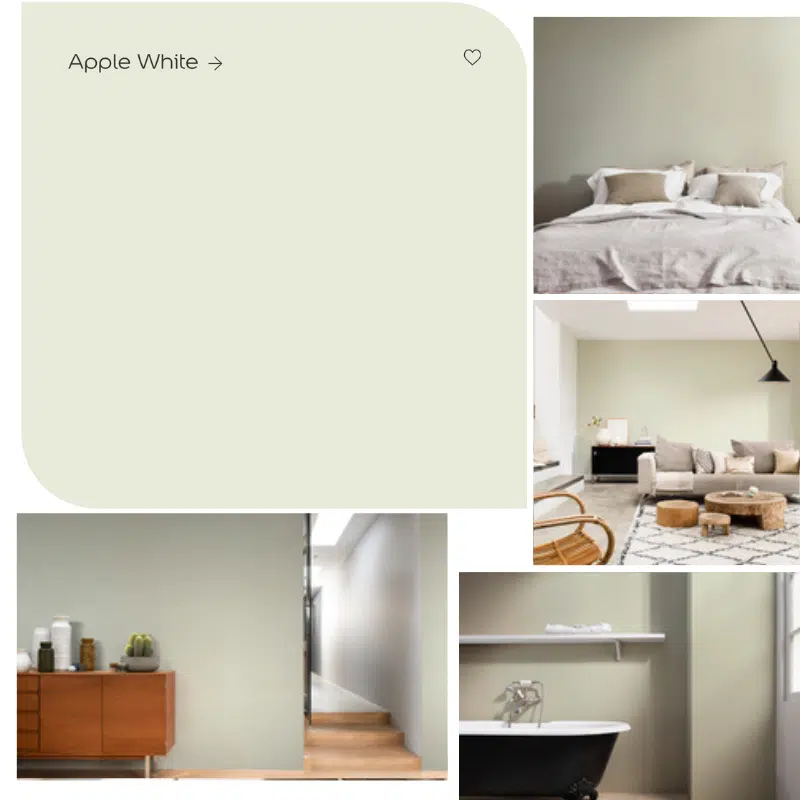
Dulux Apple White sits in that sweet spot between cream and white — warm enough to feel cosy, light enough to keep a room from feeling heavy. Choosing the wrong surrounding colours makes the whole space look muddy rather than intentional. Here is exactly what works with it, why it works, and what to avoid.
Why Dulux Apple White’s Undertone Is the Key to Getting It Right
Most people pick Apple White because it feels softer and more liveable than stark options like Dulux Pure Brilliant White. What they don’t always notice is the subtle green-yellow undertone sitting beneath its cream surface. That undertone is not a flaw — it is what makes the colour feel organic and warm. But it does mean colour pairings need to work with it rather than against it.
What the LRV Tells You About This Colour
Apple White has a Light Reflectance Value (LRV) of approximately 78–80. That puts it firmly in light territory — not the clinical brightness of a pure white, but significantly lighter than any mid-tone. In practice, this is what you will observe:
- North-facing rooms: Apple White reads noticeably creamy and warm, with the yellow-green undertone more pronounced under cool natural daylight.
- South-facing rooms: It reads almost white with just a whisper of warmth — more neutral and versatile for pairing.
- Evening artificial light: Warm bulbs push it further into golden-cream. Cool LED bulbs at 5000K or above effectively bleach it towards neutral white.
This is why testing a large swatch — at least 30x30cm painted directly on your wall — matters so much. A paint card viewed in a shop under fluorescent lighting tells you almost nothing about how Apple White will behave on your north-facing hallway wall at 3pm in February.
The Warm Undertone Rule
For Apple White, the guiding principle is simple: pair warm with warm, or go deep enough that the undertone becomes secondary. Colours that succeed either share a warm base — greens with yellow in them, beiges, taupes, warm-leaning blues — or go dark enough that the contrast takes over entirely, such as a forest green or deep navy.
The colours that consistently fail have a cool or purple-pink base. Cool greys look discordant against Apple White. Lavender and mauve-pinks make the cream read actively yellow. It is similar to pairing a warm-toned foundation with a cool-toned concealer — both suffer, and neither looks right.
Test Before You Buy — Every Time
Dulux Colour Tester pots cost around £4 each. Buy one for Apple White and one for your planned accent colour, paint them side by side on the actual wall, and check them at three different times of day — morning, midday, and evening. Do this on both a cloudy and a sunny day if you can wait. Apple White shifts more noticeably than most whites as natural light changes, and seeing that shift next to your chosen accent colour is the only reliable way to know if the pairing works in your specific room.
One additional note for anyone using Dulux Easycare Washable and Tough rather than standard emulsion — which is the smart choice for busy family rooms — the slight sheen of Easycare affects how the colour reads compared to a flat-emulsion swatch. It is a small difference but worth factoring in before you commit to 5 litres of accent colour.
The 7 Best Colour Combinations for Apple White Walls
Each pairing below works because it is compatible with Apple White’s warm green-yellow undertone, not just because it creates visual contrast. Compatibility is about shared tonal ground, not just aesthetics.
| Colour Type | Specific Paint Name | Best Room | Mood Created | Difficulty |
|---|---|---|---|---|
| Warm Sage Green | Dulux Heritage Sage and Onion | Kitchen, living room | Organic, grounded | Easy |
| Warm Greige | Dulux Natural Hessian | Hallway, bedroom | Cohesive, timeless | Easy |
| Deep Forest Green | Little Greene Pea Green | Dining room, study | Bold, traditional | Medium |
| Warm Taupe | Dulux Gentle Fawn | Any room, woodwork | Safe, classic | Easy |
| Earthy Terracotta | Farrow & Ball Red Earth | Living room, kitchen | Warm, earthy | Medium |
| Warm Blue-Grey | Farrow & Ball Mole’s Breath | Bedroom, bathroom | Calm, sophisticated | Medium |
| Deep Teal Navy | Farrow & Ball Hague Blue | Hallway, feature wall | Dramatic, classic | Confident |
The Easiest Win: Switch Your Woodwork to Dulux Gentle Fawn
If you are uncertain where to start, do this first. Switch your skirting boards and door frames from Pure Brilliant White to Dulux Gentle Fawn. It is a soft warm taupe that sits comfortably in the same tonal family as Apple White — close enough to feel cohesive, different enough to add quiet depth. The result looks deliberate rather than default. Pure Brilliant White on woodwork next to Apple White walls creates a jarring cold-to-warm jump that makes the wall colour look grubby rather than intentionally cream. Gentle Fawn solves that in a single decision.
The Statement Move: Farrow & Ball Hague Blue
Hague Blue (No. 30) is a deep, teal-tinged navy. Used on a single chimney breast or hallway wall, with Apple White on everything surrounding it, it creates serious visual impact without clashing. The reason it works is that Hague Blue carries green tones that echo Apple White’s undertone. They share common tonal ground. This is colour compatibility in practice — not just light versus dark contrast, but two colours that genuinely like each other. Farrow and Ball costs more, around £60 for 2.5 litres, but the pigment depth and coverage are genuinely different from standard retail paint.
The Practical Family Pick: Warm Sage Green
Dulux Heritage Sage and Onion on a single kitchen or living room wall gives you organic warmth that reinforces rather than fights Apple White’s undertone. The two colours share the same yellow-green base — they are from the same colour family at different saturations. Beyond the aesthetics, mid-tone greens have a real practical benefit in busy households: they hide fingerprints, splashes, and daily marks far better than pale walls. A pale accent wall next to pale Apple White gives you nowhere to hide anything. A mid-dark green accent wall earns its place both aesthetically and practically.
Colours That Fight With Apple White — Avoid These
Three categories consistently cause problems when paired with Apple White, and they are worth naming specifically rather than vaguely.
Cool greys — anything with a blue or purple base, Dulux Chic Shadow being a clear example — make Apple White read jaundiced. The warm yellow-green undertone in Apple White clashes with the cool undertone in the grey, and both colours end up looking muddy rather than intentional. Lavender-pinks are worse. They actively pull Apple White’s warmth towards visible yellow, which almost nobody intends. Pure Brilliant White on trim is the most common trap — the stark cool brightness makes Apple White walls look as though they need another coat, not finished.
One that surprises people most: Farrow and Ball Elephant’s Breath. It is one of Britain’s best-selling mid-grey-beige colours and works beautifully with many whites. But next to Apple White specifically, its cool purple-grey undertone creates exactly the muddy tension described above. Use Elephant’s Breath with Farrow and Ball All White or Cornforth White — it was designed for a cooler palette, and Apple White is not in that family.
The pattern is consistent. If a colour leans cool, blue, or purple, it fights Apple White. If it leans warm, green, beige, or deep, it cooperates. There are no grey areas here — this particular white has a clear undertone and pairings that cross it tend to fail noticeably.
Using Apple White in Family Homes With Kids and Pets
Apple White is a genuinely practical colour choice for busy households — but the finish matters as much as the colour itself, and a few pairing choices make a real difference to how the space holds up over time.
Standard Emulsion vs. Dulux Easycare: Which Finish to Choose
Use Dulux Easycare Washable and Tough on any wall that sees regular contact — hallways, kitchens, children’s rooms, any space where pets settle or move through daily. It is available in Apple White. Standard matt emulsion looks slightly more luxurious in the tin and on a fresh wall, but the surface breaks down when wiped repeatedly. After a few months of cleaning muddy paw prints or sticky handprints, you end up with visible dull patches where the finish has lifted. Easycare resists scrubbing properly. The slight sheen is barely perceptible in real-room lighting, and the colour reads identically in most conditions. For ceilings and rooms that genuinely do not get touched — a formal dining room, an adult-only bedroom — standard emulsion is a fine choice and gives a flatter, more premium finish.
Best Accent Colours for High-Traffic Family Rooms
In rooms taking daily punishment from children and animals, pale accent colours fail as quickly as Apple White alone. The combinations that work hardest in practical family-home contexts:
- Apple White above a dado rail, Dulux Natural Hessian below: A classic hallway treatment. The mid-tone lower half handles dirt, scuffs, and paw-level contact. The lighter upper half keeps the space feeling open and generous. Far more forgiving than Apple White from floor to ceiling.
- Apple White walls with a deep green accent wall: Little Greene Pea Green or a similar mid-dark green. Deep tones hide marks dramatically better than pale accent colours, while the green echoes Apple White’s undertone for cohesion.
- Apple White with warm wood flooring: Kahrs and Karndean both produce warm oak ranges in the £40–65 per square metre bracket that sit naturally alongside Apple White walls. Avoid grey wood-effect LVT — the cool-grey floor fights the warm cream wall and creates a visual tension that reads as something being wrong without being easy to identify and fix.
Does Apple White Show Pet Hair?
Light walls in general show pet hair less prominently than dark walls — and Apple White’s warm cream tone is more forgiving than stark white, where each strand reads clearly against the cool background. That said, the floor is where pet hair actually accumulates and is most visible. Grey LVT or cool stone tiles create a background that makes light-coloured pet hair highly visible. Warm beige carpet, warm oak-effect wood, or buff-toned stone flooring are better pairings for homes with light-haired dogs or cats — and all of them complement Apple White walls rather than fighting them.
When to Pick a Different White Altogether
Apple White is the wrong choice if you want a clean, contemporary, neutral backdrop. That job belongs to Dulux Timeless, Dulux White Mist, or Farrow and Ball All White.
Apple White is built for warmth and works in traditional spaces: period properties, cottage-style interiors, farmhouse kitchens, rooms where warm wood tones, natural linen, and earthy accents dominate. If your home has anthracite window frames, grey LVT flooring, brushed steel hardware, and a furniture palette built largely around greys and cool neutrals, Apple White will fight rather than complement the surroundings. The warmth reads as a mistake rather than a choice.
Dulux Almond White is the middle ground worth trying if you like the idea of Apple White but found it too yellow in your space. It is creamier than Timeless but less warm than Apple White — a gentler step towards neutral. Dulux Natural White sits between the two, warmer than a pure white without the green-yellow pull of Apple White. These are not consolation prizes. They suit genuinely different rooms and palettes, and knowing the difference saves you from repainting twice.
| Your Situation | Right White | Avoid |
|---|---|---|
| Traditional, period, or cottage home | Dulux Apple White | Pure Brilliant White — too clinical |
| Modern palette with grey tones throughout | Dulux Timeless or F&B All White | Apple White — too warm for cool surroundings |
| Warm-neutral family home | Dulux Apple White or Almond White | Any cool-grey-based whites |
| Apple White tested yellow in your room | Dulux Almond White — one step cooler | Going directly to a cool white creates a bigger jump |
| Woodwork alongside Apple White walls | Dulux Gentle Fawn or Almond White | Pure Brilliant White — creates cold contrast |


Leave a Reply