
The average Denver homeowner gets three contractor quotes for a bathroom renovation and picks the middle one. That instinct is reasonable — but it is also how people end up with a $28,000 bathroom that needed a permit pulled after the fact and a shower that leaks within eighteen months.
Denver’s renovation market has specific pressures: altitude affects ventilation requirements, municipal water hardness accelerates fixture damage, and the city’s permit enforcement has tightened considerably since 2026. What works in a Houston or Phoenix renovation guide will not cover what you need here.
This article covers real cost tiers by scope, what Denver actually requires you to permit, how to vet a contractor through Colorado’s licensing database, and which materials hold up in this specific climate — with real product names, not generic advice.
What Bathroom Renovations Actually Cost in Denver
Denver labor rates have risen steeply since 2026. Expect to pay 15–25% above national averages for skilled trades. A licensed plumber runs $95–$140 per hour. A licensed electrician bills $85–$120 per hour. Tile setters — the experienced ones — charge $12–$22 per square foot for installation alone, materials separate.
| Project Scope | Typical Denver Cost | What’s Included | What’s Usually Excluded |
|---|---|---|---|
| Powder Room Update | $3,500 – $8,000 | Vanity, toilet, faucet, paint, flooring | Plumbing moves, electrical upgrades |
| Cosmetic Refresh (full bath) | $8,000 – $15,000 | New fixtures, tile overlay, vanity, lighting | Layout changes, subfloor work, shower pan replacement |
| Mid-Range Full Renovation | $18,000 – $32,000 | Full demo, new tile, shower rebuild, fixtures, vanity, lighting, permits | Structural changes, radiant floor heat, luxury fixtures |
| High-End Full Renovation | $35,000 – $65,000+ | Custom tile, Kohler or Hansgrohe fixtures, freestanding tub, radiant heat, custom cabinetry | Addition of square footage |
Where the money actually goes
Labor typically consumes 40–50% of a full renovation budget in Denver. The biggest budget surprises come from what is behind the wall. Older Denver homes — particularly those built before 1980 — frequently have galvanized pipes that need replacing once exposed. Budget a $2,000–$4,000 contingency for this specifically. It is not a contractor trying to pad the bill; it is an actual code requirement once the wall is open.
Cost versus value at resale
Remodeling Magazine’s 2026 Cost vs. Value report shows a midrange bathroom remodel in the Mountain region returns roughly 66 cents per dollar spent at resale. An upscale remodel returns closer to 52 cents. Spending $50,000 on a primary bath to sell in two years is almost never financially sound. Design for yourself first; resale appeal follows from quality execution, not maximum spend.
Denver Permits: The Rule Is Simpler Than Contractors Make It Sound
Move a drain, add an electrical circuit, or relocate a fixture: Denver requires a permit. A cosmetic swap — same toilet location, same vanity footprint, new tile laid over existing — typically does not. Shower pan replacement is the common gray area: Denver Community Planning and Development (CPD) classifies it as structural work and requires a permit in most cases.
Skipping a required permit creates a title problem that surfaces at sale. Denver assessors have cross-referenced permit records against listing photos during the 2026–2026 enforcement cycle, and unpermitted work has triggered required remediation before closing on multiple metro-area deals. The permit costs $150–$400 and buys you an inspection that also catches a contractor’s sloppy work before it is buried in drywall. Pull it.
Denver’s Hard Water Problem and Why It Should Change Your Fixture Decision
Denver Water reports average hardness of 130–170 mg/L — classified as moderately hard. That is not the worst in Colorado (some Front Range municipalities exceed 200 mg/L), but it is hard enough to matter over a five-year horizon.
Hard water leaves calcium deposits on shower glass, corrodes chrome finishes faster than expected, and clogs aerators in standard faucet heads within two to three years of regular use. It also attacks grout — specifically unsanded grout in narrow joints — by depositing minerals that cause microcracking over time. Most online bathroom renovation guides are written for national audiences and do not account for this. Denver homeowners need to spec differently from the start.
Fixtures that hold up better in hard water
No finish is fully immune to hard water, but some perform significantly better. Moen’s LifeShine finish — available on most of their Spot Resist brushed nickel line, priced $150–$600 depending on fixture — is engineered to resist mineral spotting and has held up well in Consumer Reports’ independent testing. The Moen Genta 8-Piece Bathroom Suite runs $400–$600 for the complete set and is a solid mid-range option for Denver conditions.
Delta’s Champagne Bronze finish has become common in Denver renovations for a practical reason: the warm tone visually masks water spots between cleanings. That is not a marketing claim — it is a real functional benefit in a hard water market. Avoid polished chrome unless you are committed to weekly cleaning. It is the highest-maintenance finish in this environment and the one most contractors upsell because it is cheapest at the trade counter.
Shower glass: frameless versus semi-frameless
Frameless glass looks better. It also shows water spots more aggressively than semi-frameless with metal channels. If you go frameless — and it is genuinely worth it aesthetically — specify a factory-applied hydrophobic coating like Diamon-Fusion or ClearShield at the time of fabrication. Budget $300–$500 extra for this treatment. Without it, you will be squeegeeing daily to maintain the look you paid for.
Grout choice in a hard water environment
Wider grout joints (3mm or more) with sanded grout hold up better than micro-joints with unsanded grout in high-mineral water areas. Schluter Systems’ Kerdi waterproofing membrane combined with epoxy grout — Laticrete Spectralock is the professional tile-setter standard — creates a shower interior that resists mineral penetration from both directions. It costs more upfront. It costs considerably less than a shower rebuild in year four.
How to Find a Licensed Denver Contractor and Avoid the Bad Ones
Colorado regulates plumbers and electricians through DORA (Division of Regulatory Agencies). General contractors doing bathroom work are not separately licensed at the state level, but they must pull permits in Denver as a licensed entity. Here is the vetting process that actually filters out problem contractors:
- Check DORA’s license lookup at dora.colorado.gov for any plumber or electrician named in the bid. This takes three minutes and eliminates roughly 15% of the market immediately.
- Verify their Denver Business License through the city’s online portal. Any contractor doing business in Denver should have one. Ask for the license number before the first meeting — a legitimate contractor provides it without hesitation.
- Request a certificate of insurance with your name listed as additional insured. Not a verbal assurance. The actual certificate. This protects you if a subcontractor is injured on your property.
- Ask specifically who pulls the permit. Some general contractors use a permit expediter service, which is fine. What you are checking for is whether they intend to pull one at all.
- Get three itemized bids, not estimates. An itemized bid breaks down labor, materials, fixtures, and contingency separately. If a contractor will not provide line items, that signals poor cost control during the project.
- Search their Google reviews for the phrase “came in over budget.” This surfaces cost management patterns that overall star ratings obscure.
The most common Denver contractor problem is not the fly-by-night operation — it is the locally established company that signs a fixed-price contract and then issues change orders on nearly every decision. Demand a change order policy in writing before signing: what triggers one, what the markup cap is (15–20% on materials is reasonable), and what constitutes an approved change. Put a project completion date and a per-diem penalty clause in the contract. Most professional contractors accept this. Anyone who refuses is signaling something about their scheduling practices.
Tile and Material Choices That Hold Up in Colorado’s Climate
Colorado runs dry and cold, with significant temperature swings. A bathroom that backs to an exterior wall experiences more thermal cycling than bathrooms in more temperate climates. Material choices that work in Atlanta or Seattle behave differently here.
| Material | Colorado Climate Performance | Installed Cost (Denver) | Verdict |
|---|---|---|---|
| Rectified porcelain tile | Excellent — low porosity, handles thermal cycling well | $15–$28/sq ft | Best all-around choice |
| Natural stone (travertine, marble) | Moderate — requires sealing, reacts poorly to hard water | $22–$45/sq ft | High maintenance in Denver water conditions |
| Ceramic tile | Good — higher porosity than porcelain, fine for walls | $10–$18/sq ft | Walls: yes. High-traffic floors: no. |
| Luxury vinyl plank (LVP) | Good — handles temperature variation better than hardwood | $6–$14/sq ft | Best budget floor option; not for shower areas |
| Engineered hardwood | Poor — humidity and dry-season cycling causes movement problems | $14–$24/sq ft | Avoid in bathrooms entirely |
The large-format tile mistake
Large-format tiles — 24×24 inches or bigger — look stunning in showroom photos. In reality, they require a flatter subfloor (within 1/8 inch over 10 feet) than most Denver homes built before 2000 can deliver without significant leveling work. That adds $800–$2,000 in subfloor prep that was not in the original quote. A 12×24 rectified porcelain is the practical sweet spot: contemporary-looking, easier to install correctly, and more forgiving of minor subfloor variation.
Design Directions Currently Working in Denver Bathrooms
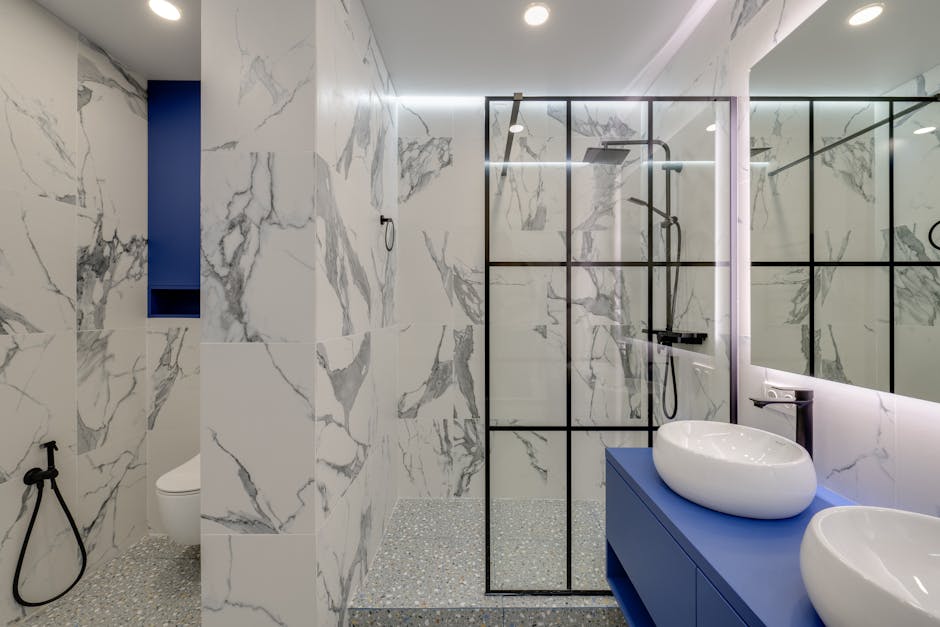
The Colorado design sensibility has moved firmly away from the cool gray-everything aesthetic of 2018–2026. What is replacing it is warmer, more textured, and more durable-looking — which tracks with a buyer demographic that has grown skeptical of renovation flips and wants to see quality over trend.
Warm whites and clay tones are the current neutral baseline. Sherwin-Williams Accessible Beige (SW 7036) and Benjamin Moore’s Pale Oak (OC-20) appear in Denver renovation projects consistently right now — not because they are trendy, but because they photograph well in natural mountain light and pair with warm-toned hardware that has broadly replaced cool chrome.
Terracotta accents — a single feature wall, a zellige tile backsplash behind the vanity — have legs in Colorado because they reference the regional palette without being overtly southwestern. Fireclay Tile produces a handmade zellige-style tile that appears frequently in higher-end Denver renovations, priced around $45–$65 per square foot installed.
Walk-in showers without tubs are still increasing as a share of Denver primary bathroom renovations. The demographic driving Denver’s renovation market — homeowners in their 40s and 50s who bought in the early-to-mid 2010s — has largely decided that a freestanding tub is for looking at rather than using, and is allocating that square footage to a better shower instead. One practical note: if you have children at home, keep at least one tub in the house. Buyers with young children treat a zero-tub house as a meaningful negative at resale, and a single tub-shower combo somewhere in the home resolves this entirely.
The Mistakes That Cost Denver Homeowners the Most Money
- Designing around a backordered fixture. Specific Kohler and Hansgrohe products — particularly their walk-in shower systems — are frequently on 10–16 week lead times. The Hansgrohe Raindance shower system ($800–$1,400 depending on configuration) is worth specifying, but order it before demolition begins, not after.
- Skipping ventilation upgrades. Denver is dry, but a shower generates significant humidity. At altitude, moisture lingers longer in upper room areas. The 80 CFM builder-grade fans in most Denver homes are inadequate. A Panasonic WhisperCeiling FV-11VQ5 (110 CFM, around $130) is the minimum for a primary bathroom and prevents long-term ceiling damage that is expensive to remediate.
- Tiling the shower ceiling without understanding the labor premium. Overhead tile work bills significantly more labor hours than wall tile. A painted ceiling using Zinsser Perma-White or Sherwin-Williams Mold and Mildew Resistant Interior Latex is a practical and widely used alternative that saves real money without a visible quality compromise.
- Choosing a vanity before measuring the rough-in plumbing. Standard vanity cabinets assume a drain centered 16–21 inches from the wall. Denver homes from the 1950s through the 1980s frequently have non-standard rough-in locations. Measure first, then shop — or specify a wall-mount vanity that allows drain location flexibility.
- Accepting a verbal project timeline. A mid-range Denver bathroom renovation takes 3–5 weeks when things go smoothly. A completion date with a per-diem penalty for contractor delays belongs in the contract. Most professional contractors accept this clause without issue.